

Learn / Renju: playing black with your hands tied
Renju: playing black with your hands tied連珠の考え方
What the forbidden shapes take from black, what white does with them, and the openings.
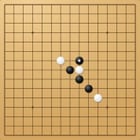 Renju
RenjuBlack's restrictions are white's weapon
Black may not make a double three, a double four or an overline. White may do all three, and white's overline wins. The point of the rules is that black's first-move advantage is worth about that much, so the two sides end up even.
For white this means one thing above all: force black towards forbidden points. A point black is not allowed to play is a point white does not have to defend. Build your shape so that black's natural winning stone would be a three-three, and black has no winning stone.
What a three is, precisely
- A three counts only if it can become a straight four with one more stone, and that stone must itself be a legal move for black. A three whose only completion is forbidden is not a three, and does not count towards a double.
- A four is any line one stone short of exactly five. A straight four with two open ends is one four, not two.
- A five wins at once even if the same stone would also have made a forbidden shape.
- The board marks black's forbidden points with a cross. Learn to see them before the marks appear; that is the skill the game is testing.
The openings
- The RIF opening confines the first three stones: tengen, then inside the 3×3, then inside the 5×5, after which white may swap colours. The twenty-six openings that result are named, and each has a known evaluation. Direct openings (直接, white's stone on a line with tengen) and indirect openings (間接, diagonal) play very differently.
- The fourth move is white's free choice and decides the character of the game. In tournament play black then offers two fifth moves and white removes one; here that step is not enforced, so black simply plays the fifth.
- A good habit for white in a swap: take black in the balanced openings and white in the sharp ones, since black's forbidden points bite hardest when the position is sharp.
The opening protocols, and which are here
Renju has spent a century balancing its opening, and the protocols are its history. Three are playable here. RIF (連珠国際連盟ルール) confines the first three stones and lets white swap. Sakata (坂田ルール) is RIF with a single fifth move that must stay inside the central 7×7, which takes away black's sharpest fifth stones. Tarannikov nests the first five stones in the 1×1, 3×3, 5×5, 7×7 and 9×9 and offers a swap after every one of them, so any stone that tips the balance is simply handed to the other player.
Three more are not built yet, because they all rest on one mechanism this board does not have: black putting down several candidate fifth moves and white removing all but one. Yamaguchi has black declare, before the swap, how many fifth moves it will offer. Soosyrv-8 declares the number after white's fourth stone, up to eight, and then offers the swap. Taraguchi-10 is Tarannikov's nested squares with a swap after each of the first four stones, after which white may instead demand ten fifth-move candidates. When the candidate mechanism arrives, all three come with it, along with the fifth-move pair in full RIF.