

Learn / Trap Three, Square Four, tic-tac-toe and the trick games
Trap Three, Square Four, tic-tac-toe and the trick games小さな盤の考え方
Games short enough to read to the end, and what reading to the end feels like.
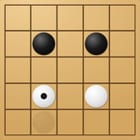 Trap Three
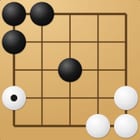 Square Four
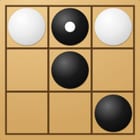 Tic-tac-toe
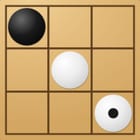 Wild Tic-tac-toe
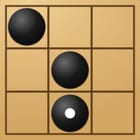 Notakto
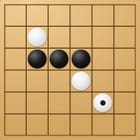 Maker and Breaker
Trap Three
- Every stone you place narrows what you can play next: a stone that would make three of your own is illegal for you in practice, because it loses. Count your safe moves, and count your opponent's.
- The winning idea is to leave your opponent with no safe move. On a 5×5 board that comes quickly. Play towards a position where every empty point makes a three for them and a four for you.
- Four is safe to make and wins. A line of two with both ends open is a threat to make four in two moves; but it is also a trap for you if the only continuation makes three. Check both.
Square Four
- The 2×2 square is the quiet win. Three pieces in an L shape threaten a square in one move; the opponent must sit on the fourth point or move a piece into it.
- In the placing phase, spread out enough to threaten both a line and a square. In the sliding phase, every move both leaves a point and takes one: look at what the piece you move stops guarding.
- The game is a draw with perfect play. Wins come from the opponent guarding the line and forgetting the square, or the other way round.
Tic-tac-toe
- The centre is the strongest first move, and a corner is the strongest reply. An edge as the first move loses to correct play.
- The only winning idea is the fork: a move that makes two lines of two at once. Every drawing strategy is a list of forks to prevent.
- It is always a draw between players who know that. That is the lesson, and the reason the bigger boards exist.
Wild tic-tac-toe
- You may place either colour, and a line of either wins for whoever completes it. So a line of two of any colour with an open end is a threat to you and a threat to your opponent equally: whoever moves next takes it.
- Never leave a two with an open end on your opponent's turn unless you are forced to. The first player wins with the centre, followed by correct play; the second player's task is to keep every line at one stone or full.
Notakto
- Every stone is black, and three in a row loses. Think of the board as a set of lines that are alive (two empty points or more, no three possible yet) and dead.
- On one 3×3 board the first player loses with correct play: the centre is the only safe start and it still loses. Count the safe moves left after each of your candidates; the player who runs out first loses, so leave an even number.
Maker and Breaker
- The Maker wants any five of one colour, whoever placed it; the Breaker wants a full board without one. The Breaker's job is easier to describe than to do: every open four of either colour must be answered with the other colour at once.
- As Maker, build two-colour threats: a black four and a white four that share no point cannot both be blocked in one move. As Breaker, place stones where they cut two lines of different colours at once, and keep every line mixed.
- On the 6×6 board the Maker is generally thought to have the edge, which is why the site lets the players change seats between games.